If you’ve been researching Transcranial Magnetic Stimulation (TMS) as a mental health treatment, you’ve probably come across a variety of device brand names and technical terms that can be difficult to understand. In this article, we clearly explain the benefits and uses of the most commonly used TMS devices, so you know what to look for when choosing a treatment.
What Is TMS and Why Does the Device Matter?
Transcranial Magnetic Stimulation (TMS) uses precisely targeted magnetic pulses to stimulate neurons in specific regions of the brain. In mental health treatment, the most common target is the left dorsolateral prefrontal cortex (DLPFC), a brain associated with mood regulation that is underactive in depression. By repeatedly stimulating this region, TMS promotes neuroplasticity, strengthening neural connections and activity in this region.
Unlike pharmaceutical medications, TMS has no systemic side effects, since no chemicals are introduced into the blood stream. The procedure requires no anesthesia or recovery time and most patients can continue their normal daily activities immediately after a session.
The TMS device itself is made up of five key components:
A typical TMS system has several main components:
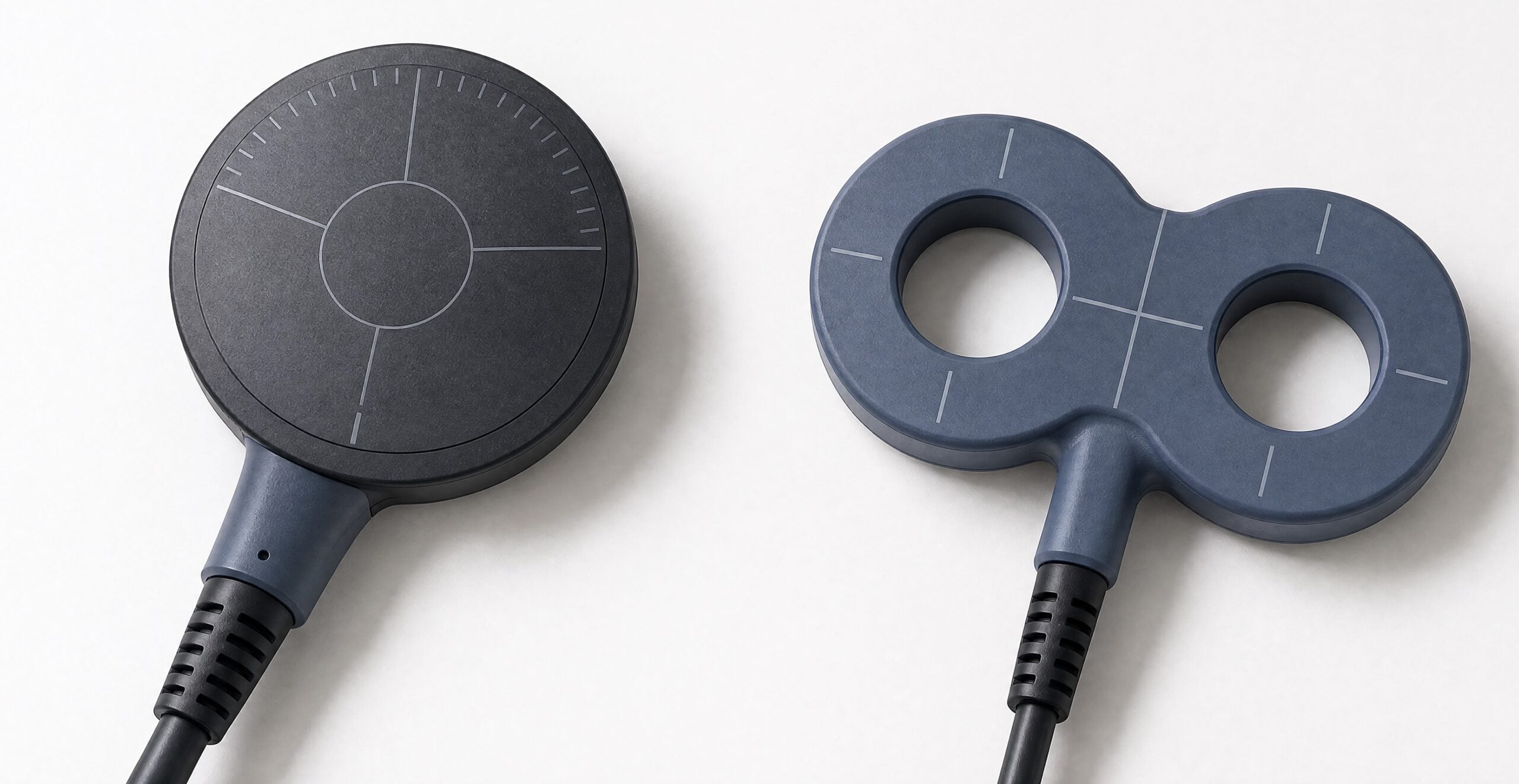
- Magnetic coil: A coil of copper wire shaped like a paddle or figure-eight that’s placed against the patient’s scalp. When electricity flows through the coil, it generates the magnetic pulses that stimulate the brain
- Pulse generator (stimulator): The main control unit of the machine which produces bursts of electricity to power the cool
- Cooling system: Many modern coils include liquid or air cooling to prevent the coil from overheating during repeated pulses
- Positioning arm or stand: Holds the coil in the correct position over the patient’s head and allows precise targeting of brain regions
- Computer and control software: Used by clinicians to set treatment parameters such as the intensity, frequency and duration of pulses.
MagVenture TMS Therapy™ System
MagVenture is a privately owned Danish medical device company with over three decades of experience in magnetic stimulation technology. Today, MagVenture operates globally across more than 70 countries and has subsidiaries in the USA, UK, Brazil, China, and Germany.
MagVenture’s systems are built around liquid-cooled coils. Unlike air-cooled systems, liquid cooling suppresses noise dramatically, making MagVenture the quietest TMS system among the leading brands. This effect makes TMS with MagVenture far more comfortable, and is particularly desirable for those with anxiety, or sensory sensitivities.
In addition, the system’s coils are also smaller and placed to the side of the head, rather than enclosing the head in a helmet or larger apparatus. This reduces the risk of claustrophobic discomfort during treatment.
MagVenture was also the first manufacturer to receive FDA clearance for the intermittent Theta Burst Stimulation (iTBS) protocol, a faster, more efficient method of delivering TMS in approximately 3 minutes per session, compared to the traditional 18–37 minutes. The iTBS protocol allows some clinics to compress a standard nine-week course into a single week of intensive treatment.
MagVenture has developed more than 35 coils for clinical and research use, offering exceptional flexibility in targeting different brain regions. As of 2025, the company has received FDA clearance to treat:
- Major Depressive Disorder (MDD) in both adults and adolescents aged 15-21
- MDD with comorbid anxiety symptoms (anxious depression)
- Obsessive-Compulsive Disorder (OCD)
- Diagnostic stimulation of the central and peripheral nervous systems
A comparison study published in PLOS ONE found that depressed patients treated with the MagVenture system demonstrated higher overall remission rates than those treated with the NeuroStar system, with the log-rank test of time to remission consistently favoring MagVenture across multiple subgroup comparisons.
Based on its comfort, versatility and effectiveness, we use the MagVenture devices at our clinic in McLean, Fairfax county. Our patients can expect compassionate expert-led care, with personalized TMS delivery protocols to best suit their needs.
NeuroStar Advanced Therapy™ (Neuronetics, Inc.)
NeuroStar received the first-ever FDA clearance for a TMS device for the treatment of depression in October 2008. Developed by Neuronetics, Inc. , a publicly traded medical technology company based in Malvern, Pennsylvania, NeuroStar has since grown into the highest-volume TMS system in the United States. As of 2025, over 8.2 million NeuroStar treatments have been delivered across more than 223,000 patients.
NeuroStar uses an air-cooled figure-of-eight coil to deliver focused magnetic pulses to the left DLPFC. The device is currently cleared by the FDA for:
- MDD in adults and adolescents aged 15–21
- MDD with anxious depression in adults
- OCD as an adjunct treatment in adults
One of NeuroStar’s standout features is its TrakStar system, a data tracking tool that records treatment outcomes from hundreds of clinics across the U.S. Over time, this has built up the largest real-world dataset of any TMS device for depression. This data is useful for showing the outcomes of TMS in everyday clinical practice rather than just in controlled research trials.
While Neurostar is one of the oldest, most well-researched TMS devices, patients and clinicians have noted that NeuroStar is a less comfortable experience than other devices. The air cooling system is generally more noisy, and pulses are sharper than MagVenture delivery systems, leading to more sensation including pain.
BrainsWay Deep TMS™ System
BrainsWay is an Israeli-American neurotechnology company. The company’s breakthrough was the development of patented H-Coils, a novel coil that distributes the magnetic field more broadly and reaches deeper subcortical brain structures than conventional figure-of-eight coils.
The company’s key coils include:
- H1 Coil: Targets the left DLPFC; cleared for MDD
- H7 Coil: Targets the anterior cingulate cortex and medial prefrontal cortex; cleared for OCD
- H4 Coil: Targets the bilateral insula and prefrontal cortex; cleared for smoking cessation
The BrainsWay system houses its H-Coils inside a cushioned, air-cooled helmet that is fitted directly to the patient’s head. The helmet design, while effective, can be perceived as more enclosing than open coil systems.
BrainsWay is the only TMS system FDA-cleared for smoking cessation. Its primary clinical advantage is its depth of field, potentially targeting subcortical brain regions that can’t be accessed with standard TMS. However, research comparing deep TMS and standard TMS for depression found no difference in effectiveness, but higher rates of side effects such as headaches and discomfort at the application site.
Nexstim NBS System 6
Nexstim is a Finnish medical technology company founded in 2000 in Helsinki. Its flagship product, the NBS System 6, is a TMS device specifically cleared by the FDA for presurgical cortical mapping of both motor and language areas of the brain. This allows clinicians to non-invasively identify critical regions responsible for movement and speech before surgery. For example, a neurosurgeon planning to remove a tumor near language centers can map the patient’s speech cortex to avoid damaging essential areas, while motor mapping helps locate regions that control movement.
Nextstim has also been approved for MDD and chronic pain (in Europe only).
What distinguishes Nexstim from every other clinical TMS system is the sophistication of its neuronavigation. Unlike other systems, Nexstim uses MRI-based 3D neuronavigation meaning the clinician can see exactly where the electric field is being delivered and in what orientation and so delivers the pulse with best accuracy.
However, compared to MagVenture or NeuroStar, there are fewer devices which have been manufactured meaning fewer clinics offer it. The NBS 6 system is also more complex to operate, requiring trained clinical professionals and substantial technical setup.
Conclusion: Why Device Choice Is Part of Your Care
Every TMS system reviewed here has genuine clinical merit and a legitimate body of supporting evidence. However, when we consider the totality of the evidence, we believe MagVenture stands out as the system best suited to deliver psychiatrist-led, evidence-based, individualized TMS care for mental health disorders.
If you would like to learn more about whether TMS is right for you, or to schedule a consultation with our team at McLean NTC, please contact our office.