Neurostimulation has become one of the most exciting frontiers in neuroscience, with techniques showing promise in treating various medical challenges, including mood disorders, neurodegenerative diseases, and chronic pain. In this article, we’ll take a look at the science and history of neurostimulation, and discuss why it is transforming the treatment of some of the most difficult-to-treat mental health conditions.
What Is Neurostimulation and How Does it Work?
Neurostimulation refers to the deliberate use of electrical or magnetic energy to control the activity of nerve cells in the brain. It works on the principle that neurons (nerve cells) communicate through electrical signals. Every thought you think, every emotion you feel, every memory you form is determined by neurons firing electrical impulses across intricate networks.
Psychiatric disorders are often linked to disruptions in these brain networks. For example, depression is commonly associated with overactivity in the default mode network (DMN), a group of brain regions involved in self-focused thinking and rumination. Anxiety disorders, on the other hand, are often linked to heightened activity in the amygdala, a region that signals threat to other areas and helps trigger the brain’s fear response. In chronic pain, networks associated with pain sensation keep firing even though they aren’t being triggered by painful stimuli.
Neurostimulation techniques work by delivering targeted energy, either with electrical currents or rapidly changing magnetic fields, to specific brain regions. This energy can increase or decrease neuronal firing, helping re-regulate brain circuits.
What makes neurostimulation particularly compelling for psychiatric care is that it offers a mechanism for acting directly on brain circuitry in ways that medication alone often cannot. Whereas antidepressants work systemically, affecting the entire brain’s neurochemistry, neurostimulation can be targeted to the precise regions implicated in a given condition.
As well as modulating neural circuits, neurostimulation has various downstream effects that researchers are still trying to understand. Studies show that neurostimulation techniques like transcranial magnetic stimulation (TMS) can alter the balance of neurotransmitters, which are chemical messengers in the brain that play a key role in mood and cognition. Neurostimulation can also increase neuroplasticity, the brain’s ability to re-structure and form new neural connections.
The Development of Neurostimulation
One of the earliest recorded uses of electrical stimulation for therapeutic purposes dates back to 46 AD, when electric fish were reportedly used to treat headaches, an early example of bioelectrical pain modulation.
Nearly 1700 years later researchers performed experiments to prove that the brain was electrically active and by the late 1800s, scientists began applying electrical stimulation directly to the brain in animal studies, showing that stimulation of motor areas could produce movement. This period marked the first experimental link between brain regions and function through stimulation.
Based on this research, psychiatrists Ugo Cerletti and Lucio Bini developed electroconvulsive therapy (ECT) in the 1930s. ECT became one of the first widely used brain stimulation treatments for psychiatric illness. The technique became refined in the decades following by introducing anesthesia and muscle relaxants to dramatically improve the safety profile of ECT.
From the mid 20th century, neurostimulation techniques became much more refined. In the 1940s, researchers developed stereotactic neurosurgery, allowing precise placement of electrodes in the brain. This led to the development of implantable devices like deep brain stimulation (DBS) and vagus nerve stimulation (VNS). Unlike ECT, which affects the whole brain, these technologies provide targeted treatment which leads to far fewer side effects.
A major breakthrough came with the development of TMS in the 1980s. Building on earlier work showing that magnetic fields can induce electrical currents, researchers developed safe devices that could stimulate the brain non-invasively through the skull.
TMS represents one of the most advanced forms of neurostimulation to date. Unlike other techniques, it requires no anesthesia, or surgery, and patients can resume their daily life following treatment. The FDA first approved TMS for depression in 2008, and have since approved its use in smoking cessation, anxious depression and obsessive-compulsive disorder (OCD). The technology continues to be used by patients across the globe, with a growing body of evidence for its safety and effectiveness in treating a wide range of psychological conditions.
Modern Forms of Neurostimulation
Here is a more in-depth look at the different forms of neurostimulation techniques used today:
Electroconvulsive Therapy (ECT)
ECT is still used today for severe, treatment-resistant mental illness. Modern ECT is performed under general anesthesia and involves brief electrical pulses delivered to the scalp to induce a controlled seizure.
It has relatively high response rates of around 50–70% in patients with treatment-resistant affective disorders and schizophrenia. However, its psychological risks, particularly memory disruption, means it’s only used in urgent clinical cases.
Transcranial Magnetic Stimulation (TMS)
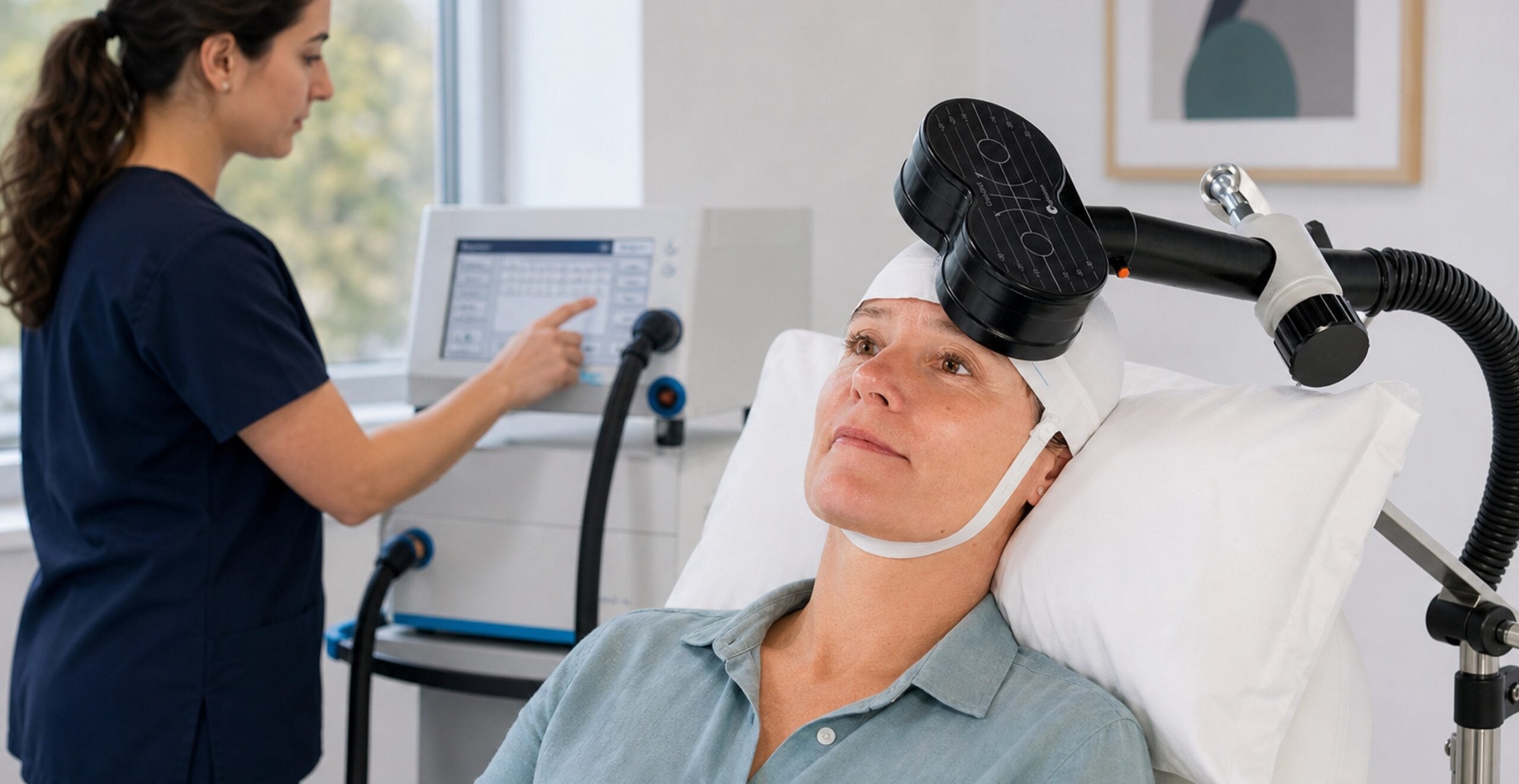
TMS uses a coil placed against the scalp to generate a rapidly changing magnetic field, which in turn induces small electrical currents in the underlying cortex. It is the most widely accessible form of neurostimulation in clinical practice today, showing notable benefits for patients with several disorders including depression, anxiety, addiction and obsessive compulsive disorder. TMS frequently offers relief to patients who have failed to respond to conventional treatments.
The most common protocol in TMS involves directing a series of magnetic pulses to the left dorsolateral prefrontal cortex (DLPFC), a region which is typically underactive in people with depression. Sessions typically last between 20 and 30 minutes.
Deep TMS (dTMS)
DTMS is a form of TMS that uses specially designed coils capable of stimulating deeper and broader regions of the brain than conventional TMS coils. This broader reach is particularly relevant for conditions involving deep brain structures. However, there’s no strong evidence suggesting that dTMS performs better than standard TMS when it comes to treating mental illness.
Deep Brain Stimulation (DBS)
DBS involves surgically implanted electrodes that deliver continuous electrical stimulation to specific brain targets. It’s primarily used for movement disorders such as Parkinson’s disease and is being investigated as a treatment for severe, intractable depression.
While there’s strong evidence to support its effectiveness, DSB is a very invasive technique that requires surgery and so it’s generally used as a last resort.
Transcranial Direct Current Stimulation (tDCS)
TDCS is a non-invasive brain stimulation technique that delivers a very low, constant electrical current to the scalp using two electrodes. Rather than directly triggering neurons to fire, it subtly shifts the likelihood that neurons will activate by making them slightly more or less excitable.
TDCS has been explored in conditions such as depression, anxiety, chronic pain, and stroke rehabilitation, as well as in cognitive enhancement research for attention and learning. Potential benefits include its low cost and relatively mild side-effect profile. However, its effects tend to be modest and variable between individuals, and the evidence base is still mixed.
Wearable Devices
Wearable neurostimulation devices extend neurostimulation techniques into home-use formats, typically using headsets or ear-clip devices designed to be used repeatedly over time. These systems aim to modulate brain activity indirectly through scalp currents and are being explored for treating different conditions such as depression, anxiety, insomnia, and stress-related disorders.
These devices could provide accessible at-home adjuncts to therapy or medication, however, stimulation is weaker and less precisely targeted than to clinical-grade devices. Moreover, there’s very limited large-scale clinical evidence to support the effectiveness for many consumer devices.
Explore Neurostimulation at McLean NTC
At McLean neuropsychiatric treatment centre (NTC), we are proud to be a leading provider of TMS therapy, combining clinical expertise with a commitment to evidence-based, individualised care.
We believe that TMS is the best form of neurostimulation when it comes to psychological treatment. Consistently, studies show TMS provides long-lasting symptom relief to patients, even when other treatments have failed to work.
Our team understands that psychiatric conditions are as varied as the individuals who experience them. That is why we approach neurostimulation not as a one-size-fits-all solution, but as a precision tool. We thoroughly review each patient’s medical history, and personal goals to determine a treatment protocol best suited to their needs.
If you or a loved one would like to learn more about neurostimulation at McLean NTC, we invite you to contact our team to schedule a consultation.